

Fan-out queries, the additional search queries that Google’s AI Mode performs and uses to generate its answers, have a major impact on which websites and brands are recommended.
That’s why we wanted to understand how much switching models changes Google AI Mode and, to some extent, AI Overviews (according to Google’s Robby Stein, this applies to more complex queries). We also wanted to understand how important it will be to recalculate fan-out queries generated by older Gemini 3.x Flash models using the new Gemini 4 Hydrogen.
The result? For commercially oriented prompts, the differences are significant.
You can also use our fan-out query analysis tool to explore these changes.
How is Gemini 4 Hydrogen different?
It generates far more fan-out queries
The new model often searches for much more detailed information. More than half of the fan-out queries involved looking up information about a specific brand or comparing multiple brands using the OR operator in Google Search.
The model generated an average of 7 fan-out queries per test (with high reasoning effort). That’s several times more than Gemini 3.6 Flash.
More fan-out queries also mean more sources to draw information from and the ability to retrieve more detailed information.
Pay attention to prompts that previously had no fan-out queries
While Gemini 3.6 Flash answered more than 20% of prompts without generating any additional fan-out queries, that figure dropped to just 1% with Hydrogen.
These are exactly the prompts where we’re seeing the biggest differences in answers. I definitely recommend taking a closer look at them.
How has the type of information AI Mode searches for through fan-out queries changed?
Whether AI searches for specific years, brands, people, or listicle articles through fan-out queries depends heavily on the prompts being tested. So please don’t treat these results as an industry benchmark. However, they do illustrate just how much the selection of fan-out queries is changing.
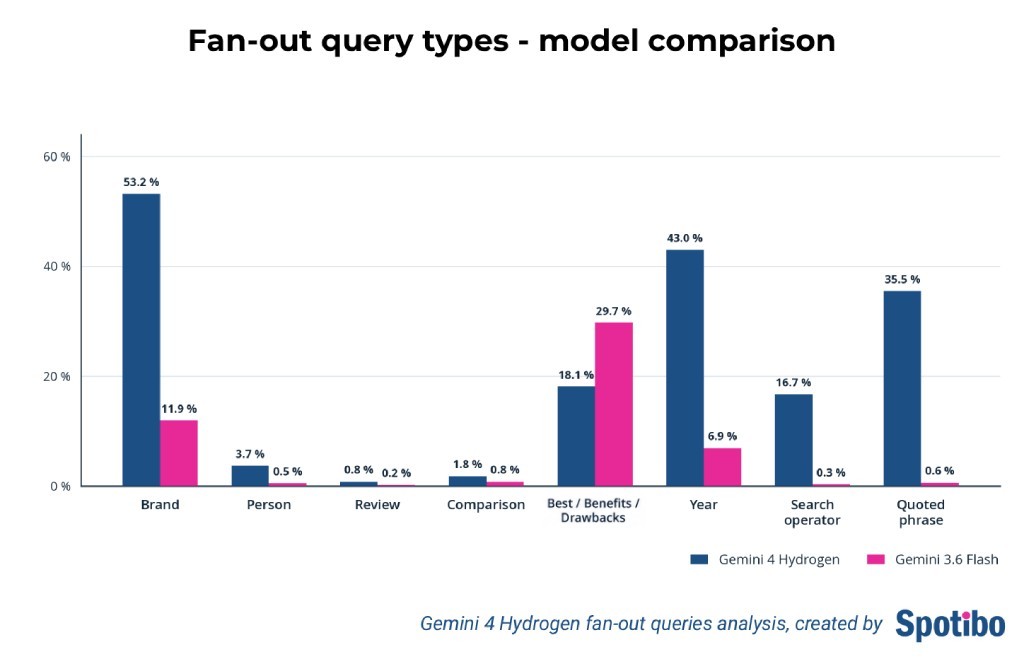
| Type of information in fan-out queries | Gemini 4 Hydrogen | Gemini 3.6 Flash | Fold change |
|---|---|---|---|
| Brand | 53.2% | 11.9% | 4.5× increase |
| Person | 3.7% | 0.5% | 7.4× increase |
| Review | 0.8% | 0.2% | 4× increase |
| Comparison | 1.8% | 0.8% | 2.3× increase |
| Advantage or disadvantage/limitation (words such as “best”, “top”, “discontinued”, “shut down”, etc.) | 18.1% | 29.7% | 1.6× decrease |
| Year | 43% | 6.9% | 6.2× increase |
| Search operator | 16.7% | 0.3% | 55.7× increase |
| Quoted phrase | 35.5% | 0.6% | 59.2× increase |
With a few exceptions, Hydrogen searches for more of almost everything.
Is Hydrogen searching more often for the upcoming year 2027?
Not yet (as of 13 November 2026). The current year, 2026, still dominates. It appears in almost every fan-out query that contains a year (99.81% of cases). These queries look something like “top fintech SEO agencies 2026”.
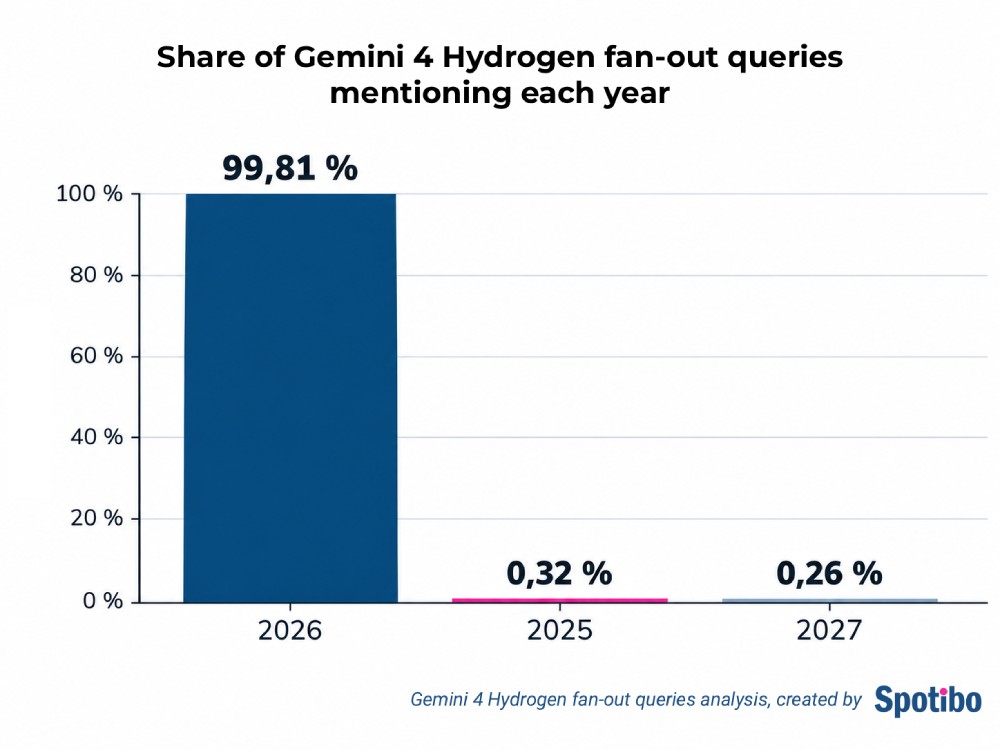
| Year | Share |
|---|---|
| 2026 | 99.81% |
| 2025 | 0.32% |
| 2027 | 0.26% |
However, specific years now appear in fan-out queries 6.2 times more frequently.
Make sure your content is up to date and that AI can easily identify when the information was published or last updated, including the relevant year.
About the analyzed data
In total, we analyzed 500 prompts, with 4 repetitions each. Half of the prompts were in English, while the other half were in other languages. We used Gemini 4 Hydrogen with high reasoning effort. We don’t know what reasoning effort level is actually deployed in Google AI Mode or AI Overviews.
Topics analyzed
E-commerce, SaaS, and B2B services. All prompts had commercial intent.
Length of input prompts
The prompts averaged 13 words. The shortest had 6 words, while the longest had 22.
We focused more on describing real user needs rather than short keyword-style phrases, which are more typical of AI Overviews.
The overall distribution was as follows:
| Number of words per prompt | Share |
|---|---|
| 6–10 | 34.7% |
| 11–15 | 27.4% |
| 16–20 | 35.5% |
| 21–25 | 2.4% |


